


Market Overview
The new year begins much in the same way as the last one ended, with US politics dominating much of the discourse. The Trump administration has removed the Venezuelan President and has provided a narrative for the decision based largely on oil. Given there’s a glut of oil at the moment (i.e., ample supply) this seems a touch incongruous. It’s also difficult to imagine US oil companies, who have been burned many times in Venezuela (i.e., via foreign seizure of assets) being all that excited to throw billions of dollars in capital expenditure to upgrade dilapidated and aged oil infrastructure in light of that glut.
To recap the past month, and really, year, it was one of global equity dominance. Small caps, Europe, the emerging markets were very strong, aided by improved corporate earnings, low initial valuations, and supportive policy via interest rate cuts and fiscal stimulus (e.g., Europe reindustrialising in the face of US tariffs, and remilitarising in the face of Russian threats).
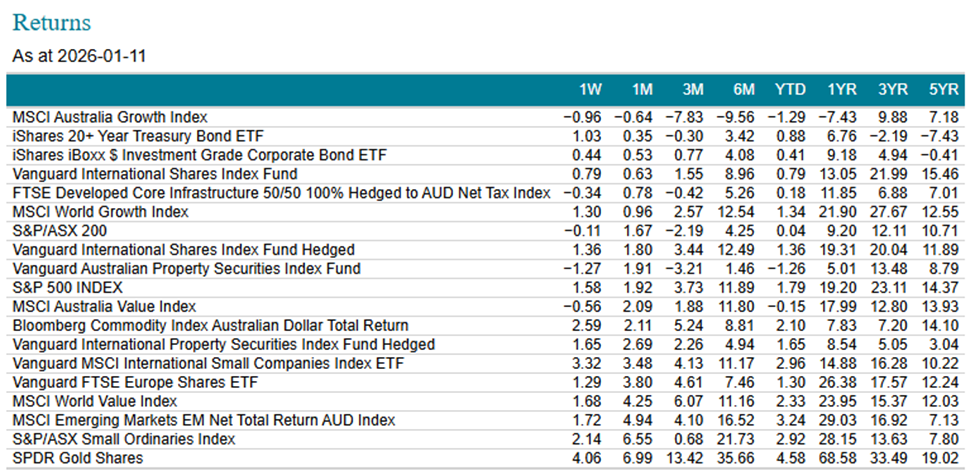
The “debasement trade” remained alive and well, with silver and gold (precious metals) enjoying stellar returns. Longer duration bonds suffered, as 10-year yields rose.
Global shares
China’s equity market continues to produce strong returns, even as their overall economic data continues to weaken. The implosion of the property bubble continues, with housing starts down more than 50% from their peak, similar to what we saw in the US housing bust that preceded (caused) the Global Financial Crisis. China has broadly offset the impact through increased manufacturing exports (e.g. solar panels, steel, electric vehicles) whilst also transferring losses to larger, better capitalised firms (absorbing smaller banks suffering from loan losses into bigger banks, for example).
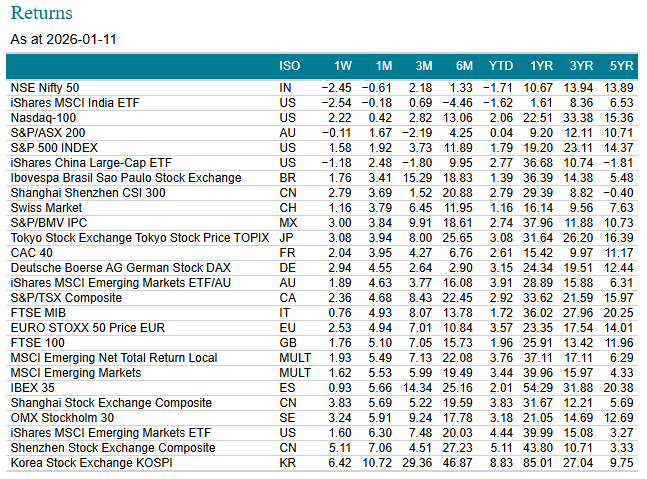
Australia’s equity market has done well over the past year, not far from a 10% return, however this has been well below international equity markets on average. Partly this is due to a relatively recent decline in the bank stocks (led by CBA) where flattish earnings combined with high valuations caused investors to rotate away from financials and into resources, but also due to the resource volatility itself, where boom-bust-and-back-again is the norm. Lithium, for example, began the year with no friends, and is now about as popular as gold in terms of retail buying interest.
Japan remains a notable call-out; the new prime minister Sanae Takaichi has embarked upon a sizeable fiscal stimulus program, at a time when the economy is already broadly strong (the unemployment rate in Japan is closer to 2%, stunningly low when we compare it countries like the UK, Australia, or Canada) and Japanese corporates continue to clean up their capital structures (unwinding cross holdings, and buying back stock), all of which has supported their equity market.
Australian shares
In the local market, material stocks have dominated returns, with a stellar run in gold and precious metals. Industrial metals like copper and aluminium have also rallied, driven by supply issues. Many of the global top 10 copper producers have all downgraded production guidance, and continue to suffer from just about every conceivable issue, ranging from delays in bringing on new mines, discovering new deposits in the first place, negotiating with unions, and offsetting grade declines.
Demand also continues to surge, as the “electrify everything” phenomenon continues. Solar modules, wind farms, and electric vehicles all use lots of copper, and lots of aluminium. The same theme has also underpinned lithium. Iron ore has been the laggard, however even then prices above US$100/tonne are still very attractive to the likes of BHP, RIO, FMG.
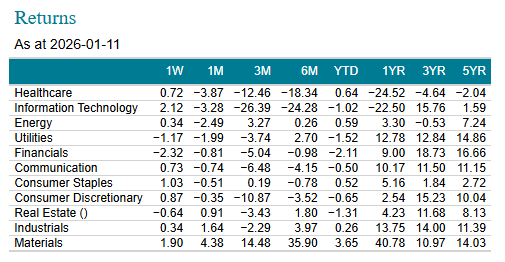
Information technology has been, by contrast, much weaker. The rise of large language models (LLM), and the belief these models can bring about artificial general intelligence, a thematic so supportive to the likes of NVIDIA (who makes the chips) or to the Magnificent 7 (Microsoft, Apple, Google etc, who own the models) is viewed as a threat to the strategic moats of many of the ASX listed tech names, which range from Xero (accounting software) to Carsales (online ads) to Netwealth (platforms). If a bright 15 year old coding in their garage can recreate the complex models these companies use on the cheap than it is very possible those kinds of companies are at risk. In part, that’s why investors are rotating towards “real assets”, like commodities, because AI is not a threat to those molecules, whereas it’s clearly less obvious for the others.
It’s also the case that the sector was simply very expensive, and thus an emergent competitive threat was all the spark the dry kindling needed. We’ve become a little more constructive on the sector given the dramatic repricing. Take Carsales; the moat is mostly the network effect. People look at Carsales because that’s where the cars are, and people list there because that’s where the eyeballs are, and vice versa. That’s a reinforcing effect, and the network value grows with the number of platform participants. That’s quite hard to dislodge, and the advertising dollars required to bring new eyeballs to new platforms would seem to be the main ingredient, as opposed to recreating the platform itself via an LLM.
Investment Outlook
Looking back over the past year, it’s striking how few of the “classic” market-timing signals worked. Take the yield curve, for example – particularly the spread between the 10-year and 2-year U.S. Treasury yields – which for decades had been among the most reliable indicators of an approaching recession. Historically, when longer-term rates fell below shorter-term rates and the spread turned negative, a recession often followed. Yet over the past couple of years, that signal was clearly triggered and no recession materialized. Investors who adjusted their portfolios based on it would have missed out on subsequent gains.
The same is true for PMIs (Purchasing Managers’ Indexes), another historically powerful economic indicator. These surveys gauge new orders, current business conditions, and pricing pressures, with readings below 50 signalling contraction. PMIs fell below that threshold more than a year ago—and still no recession arrived. Once again, investors attempting to time markets and reallocate assets based on this signal would have forfeited further upside.
Given the extraordinary level of intervention in financial markets under the Trump administration, most notably through tariffs, and the widespread expectation that the more damaging aspects of those policies would trigger a recession, the outcome has been strikingly different. Those recessionary effects simply never materialized. There are sound reasons for why that happened, but even so, if we take stock of what was widely viewed as disastrous at the time and then fast-forward to the actual performance of global equities, the gap between expectation and reality is enormous.
Before I bore you with too many examples, lets finish on consumer confidence and housing. When consumers are feeling good, they spend, when they are fearful, they don’t. Historically this was a simple yet superb measure to follow. Well, consumer confidence was at recessionary levels for almost all of the prior year. It also used to be the case that “housing WAS the business cycle”, with housing development (permits, approvals, starts, construction) reliably leading the overall economy up or down over time. With housing construction firmly in recession, but GDP trundling along, the disconnect has never been more pronounced.
What to take away from all this? Well, we’ve had to downweight some of the macroeconomic significance of our models, and instead upweight (paying more attention to) measures that are akin to momentum (the tendency of assets that are rising to keep rising, or those that are falling to keep falling) whilst simultaneously hunting for pockets of reasonable valuation, where starting yields are one of the better predictors of subsequent return. That’s led us to ex-US equities, real assets like property and infrastructure, and to a lesser extent commodities.
We continue to emphasize that the only true free lunch in markets is diversification. Equally important is time in the market, long-term investing remains a core requirement for success.
Looking ahead, we continue to view longer-dated government bonds, currently yielding between 4–5%, as excellent portfolio ballast. While rising yields have been a short-term drag on performance, this has largely been offset by the strong returns generated by the equity allocations within our diversified portfolios. Should conditions deteriorate, whether through further weakening in U.S. labour markets, renewed global uncertainty stemming from Trump-era policies, or a downturn in U.S. housing spilling over into other sectors, we would likely be grateful to have that defensive exposure in place.
The outlook for credit is somewhat more mixed, with low defaults resulting in low spreads to government bonds. However, because the risk free rate is material, the all-in yield on investment grade credit remains sufficiently appealing to warrant a position in the portfolio.
For equities, we remain overweight international, and slightly underweight domestic equities. The ASX strikes us as modestly expensive, with a clear tailwind to half the market (commodities) and clear headwinds to the other half (banks, speaking very generally). The RBA is also possibly set to reverse course on an easing cycle, in response to sticky inflation and tight labour markets. Thus we may lose the valuation support of more accommodative policy.
Our preference within international remains weighted to ex-US equities (although the US is still a very sizeable chunk of the overall exposure). Earnings growth is expected to remain robust, it’s just that the equity risk premia in the US is, simply put, very low, and better spreads are on offer elsewhere. Around a 1/3rd to a half of our international equities exposure is typically hedged, given that we see upside risks to the AUD, driven by strength in the terms of trade, and via an elevated interest rate differential. It’s also possible that modest risk premia wedges itself into the USD, as investors uncertain about US policy look to diversify their holdings.
EWK Investment Committee
Important information:
Past performance is not a reliable indicator of future performance.
General Advice Warning: This document has been prepared without taking into account your objectives, financial situation or needs, and therefore you should consider its appropriateness, having regard to your objectives, financial situation and needs. Before making any decision about whether to acquire a financial product, you should obtain and read the relevant Product Disclosure Statement.